Monday, May 17, 2021

Apollo Soyuz Retro 51

PBL Exclusive Apollo Soyuz Retro 51


The Soyuz as seen from the Apollo CSM
The Space Race, an era of fierce competition be
tween American and Soviet space programs which led to some of the most impressive and inspiring feats of human ingenuity ever seen, was bookended by two events: the launch of Sputnik in 1957, and the Apollo-Soyuz Test Project in 1975. After almost 20 years of breakneck progress from both sides, which gave us the first man in space, the first spacewalk, the moon landings, and countless other achievements unimaginable a generation before, NASA and their Soviet counterpart the Soviet Academy of Sciences worked together on the Apollo-Soyuz Test Project to kick off a new age of international cooperation in space, the spirit of which lives on today in projects like the International Space Station.

In 1970, the administrator of NASA sent a letter proposing a joint orbital rendezvous between spacecraft from the US and USSR, and the next five years were spent training astronauts and building equipment from both countries to deal with the challenges created by the significant cultural, engineering, and design philosophy differences between the two space programs. The differences in how each organization approached spaceflight were profound, and led to significant difficulties as they worked together to integrate their respective systems.


The American space program we all know and love thinks of astronauts like pilots, "flying" their spacecraft with a similar level of involvement to a pilot flying a plane. In fact, NASA to this day teaches all astronauts who aren't already pilots coming into the program how to fly jets, because they believe having the mindset of a pilot is valuable in space. This approach requires highly trained and relatively independent crew members with an intimate understanding of their craft, but allows for creative solutions in dire circumstances like what happened on Apollo 13. This was diametrically opposed to the Soviet attitude towards their cosmonauts, who were treated more like passengers than pilots. Much of the involvement required of American astronauts in spaceflight was automated for their Soviet counterparts, which has the obvious benefits of reducing required training time and sources of potential human error, at the cost of significantly reduced adaptability.

Mission control in Houston
Another massive difference between the two approaches to spaceflight was their attitudes towards redundancy. In the American space program, a seemingly excessive level of redundancy is expected for all critical components where possible. As an example of this mindset, the computer that did the mission critical calculations for the space shuttle existed in triplicate; three independent computers would do every operation and vote to decide what to do. If one computer consistently voted against the majority, there was a fourth backup that the crew could hook up to replace the suspicious hardware. This was not an attitude shared by the Soviets in their space program. In Soviet craft like the Soyuz, everything had a specific purpose, and if there were any failures of critical equipment, the plan was to abort at earliest convenience. The obvious drawback to this philosophy is that an abort isn't always possible and there's potential for otherwise avoidable loss of life, but this is a less significant risk in the low earth orbit regime Soviet spacecraft operate in, as opposed to the long haul journeys to the moon and back the Apollo module was designed for. 

Perhaps most difficult to overcome from a technical standpoint was the incompatibility of the two craft's atmospheres. Prioritizing flame resistance, the Soyuz capsule had a mixed gas atmosphere similar to air at about sea level pressure, as there's a significantly reduced risk of fire inside the capsule compared to a pure oxygen environment with the addition of relatively inert nitrogen. Conversely, the Apollo command module used pure oxygen at 1/5th atmospheric pressure, because it's just as easy to breathe as normal air, but puts less strain on the walls of the capsule and allows for widespread weight savings. Had the two countries not worked together to build the Androgynous Peripheral Attach System (APAS), a unique two-sided airlock that bridged the two spacecraft and served as an adapter between their respective docking standards, the Soyuz side would likely have gone up in flames, and the Apollo side may have popped like a balloon. 
The crew of the mission


On the crew side, the 3 Americans and 2 Soviets who would go on the mission all learned Russian and English respectively, and spoke the native language of the other side for the duration of the rendezvous. According to the oral histories of the American astronauts, while they were training in Russia, they suspected their hotel rooms might be bugged. To test the theory, one of them loudly bemoaned the lack of a pool table in their hotel's lounge. Sure enough, the next morning a pool table had conveniently appeared. While together in orbit, the two crews exchanged 5 flags from each country, addressed TV audiences from around the world, and enjoyed the company of their counterparts in an unprecedented display of unity between the two Cold War powers.

This was the last flight of an Apollo module, as it would soon be replaced by the Space Shuttle as NASA's primary launch vehicle. On the Soviet and now Russian side, the Soyuz is still flying astronauts and cosmonauts to the ISS to this day, and isn't expected to be replaced until at least 2023.


The Pen Boutique exclusive Apollo Soyuz Retro 51 commemorates this iconic moment in the history of space exploration in spectacular fashion. The sky blue upper section of the pen represents the Soyuz capsule, with its two distinctive blue bands. The bottom section's minimal markings, bare metal finish, and cross-shaped R-4D attitude control thrusters represent the exterior of the Apollo CSM, the same craft which carried the crew of Apollo 11 to and from the moon just 6 years prior. Bridging the two sections representing each spacecraft is a grey section representing the APAS, the most concrete example of the hurdles facing this mission and the inspiring efforts taken to overcome them. 

This is a limited edition of only 300 rollerballs, so act quickly if you want to own this beautiful tribute to international cooperation in space!
Read more »

Thursday, May 13, 2021

Ready for your first fountain pen?

 Taking a Closer Look at Starter Fountain Pens

    *Speaking from my own experience* When I first got exposed to the fountain pen hobby I was a little intimidated by all the options and seemingly overwhelming knowledge I thought I needed to have in order to start using a fountain pen. In reality it is not anywhere near as complicated as I thought it would be and to hopefully help you with your decision for your first or second fountain pen. Seeing as how this list is aimed for beginners in the hobby I will be focusing on pens under the $75 dollar mark so that there is something for everyones beginner budget. The list is in no particular order other than by price and I have not ranked these in terms of performance or anything else like that, I'm confident that each one of these pens will serve a beginner well and will be a mainstay even in a growing collection. Now that the introduction is out off the way let's take a look at the first of 5 pens on this list from the Japanese manufacturer Pilot.

Pilot Metropolitan

    The Pilot Metro is a great example of how Pilot does everything from ultra-high end pens to starter pens very well and does not leave one for the other. The great thing about the metro is that they are built very strong with a metal construction which makes them great options for students that want a reliable writing instrument without it being overly precious. They also come in a wide variety of colors with some more toned down colors that would be fit for a professional setting or bright fun colors to brighten up your school pencil pouch. The pens fill with a cartridge converter system like most of the other pens coming up on this list and this is actually why I prefer it to the one-off platinum preppy or pilot varsity. 
    The reason for this is that by having the filling systems in the pen you can not only reuse your pen but it also teaches people (at least me) about the permanence that writing utensils can have which is not something I really thought about before getting in the hobby. The cartridge option also allows for easy refills of the pen when you aren't near an ink bottle or in a setting that the ink bottle may be too messy, for cartridges just take the old one out and pop a new one in if they are the same color. The Pilot Metropolitan is available in a Fine, Medium or Stub nib in 14 different colors from Pen Boutique for the price of $23.99 making it the least expensive option on our list and it packs a wallop for only 24 dollars.

Lamy Safari & Al Star

    Next up we have my personal favorite and the first fountain pen I ever owned and that is the Safari from the German pen brand Lamy. The Safari holds a special spot in my heart because it was my first pen but it also holds its own on this list through its iconic design and rugged construction. Something else that makes the Safari a great starter option is that the nibs are easily removable and can be purchased separately so people can try out different sizes to see what they enjoy before moving into the more expensive pens where an extra nib gets significantly more expensive. Much like the Pilot Metropolitan the safari is available in a number of different fun colors but also in more basic ones so that they can fit into any setting whether it's school or work. The picture above contains the two special edition models for 2021 which is another thing that makes the Safari a little more collectible than some of the other pens on this list, there are many many special edition colors to track down and collect. 
Now if you do prefer the metal finish of the Metropolitan Lamy gave their Safari a metallic makeover and called it the Al Star after the aluminum metal used for the body of the pen. Essentially the same function as the Safari, the only differences between the two models is that the Al Star is made of metal and also has a clear section which is purely aesthetic and since both pens use the same nibs they write the same and are interchangeable. The Al Star comes in a variety of colors as well but they tend to be a bit more muted as it is hard to get the saturated color of the safaris on the aluminum during the anodization process. Both the Safari and Al Star models can be purchased at Pen Boutique in a variety of colors and in nib sizes ranging from Extra fine, fine, medium, and broad for $29.60 if you get the Safari and $37.60 for the Al Star.

Twsbi Eco

    The Twsbi Eco is unlike any other pen on this list and after seeing the picture it should be pretty obvious why that is, it's completely clear! Not only is it clear but the filling mechanism is different from the other pens on this list as well, its a piston filler. This means that instead of using a converter you can think of the whole pen as the converter which allows for a larger ink capacity and the clear design allows you to keep an eye on the ink level. 
    As you can see the Eco is no stranger to a bit of color either and much like the Lamys, these come out in some special edition models and colors occasionally which makes them collectible as well. With this pen being a piston filler it limits you ink options to bottle ink so it may prove hard to ink up if it runs out away from home but since the pen is a demonstrator you can pretty easily keep an eye out for when its getting low and fill it up before you go out. The Twsbi Eco can be purchased in 12 different colors in nib sizes ranging from Extra Fine, dine, medium, broad, and a stub for the price of $32.99.

Sailor Compass

    The Sailor Compass was a fantastic choice and addition to the models of the Sailor pen company and this is because it is a significantly less expensive model than their most popular pro-gear, 1911 and king of pen models. By no means am I saying that those pens are too expensive or over priced but it is nice to see them offer a pen under $100 that is still produced with the quality and attention to detail that Sailor has been known for for over 100 years. If you haven't noticed the color pattern between all the pens on this list, the compass is no exception and is offered in 9 eye-popping colors that are sure to bring some festivity to your writing experience. Something that's very unique about the compass is that the plastic feed is actually clear which gives a really cool look to the pen, it captures the color of the ink that you are using. 
    Another really nice thing that Sailor has done is that they include both cartridges and a converter with the pen so you can get writing right away and the converters that they give you match the pen's color which is something pretty unique that gives the pen a cool look. This pen in short, is a great budget offering from Sailor that is sure to lead to one of their gold nabbed models that I mentioned earlier so be careful, you won't know what hit you until after you own one of their exquisite gold models. The Sailor Compass is available at Pen Boutique in 9 colors for the price of $39.20.

Read more »

Tuesday, May 11, 2021

A Walk in the Park

 A Closer Look at the Parker Pen Brand

History

    The origin of the Parker pen company is like that of other pen brands that are now con sided staples, George Safford Parker wanted to own a pen that was reliable and that didn't leak. The brand was established in 1888 by George Parker and he was able to patent his first pen just a year into the companies establishment. Parker became a big contender in the pen market around 1894 which is when they first patented the "Lucky Curve" feed system which would allow excess ink from the feed to flow back into the reservoir preventing leaks and prolonging ink usage. 
    1903 saw Parker expand their horizons to a global market and essentially went on a world tour to showcase what they were doing in the world of pens at the time. It wasn't till 1911 that the Lucky Curve system was actually patented after small improvements which saw more and more of them introduced to the market. In 1918 the Parker pen company would surpass an annual revenue of $1,000,000 which, adjusted for inflation, would be approximately $19,000,000 in 2021 which is pretty remarkable just coming out of a war. 1921 saw the brand release one of the most famous and iconic fountain pens to date, the Parker Duofold, vintage models are still highly collectible and sought after to this day. 
The company would continue to come out with pens that are now considered to be classic like the Vacumatic in 1933 and the 51 in 1941. Enough of the brands rich and flourishing history, lets take a look at their current offerings available through Pen Boutique.

51

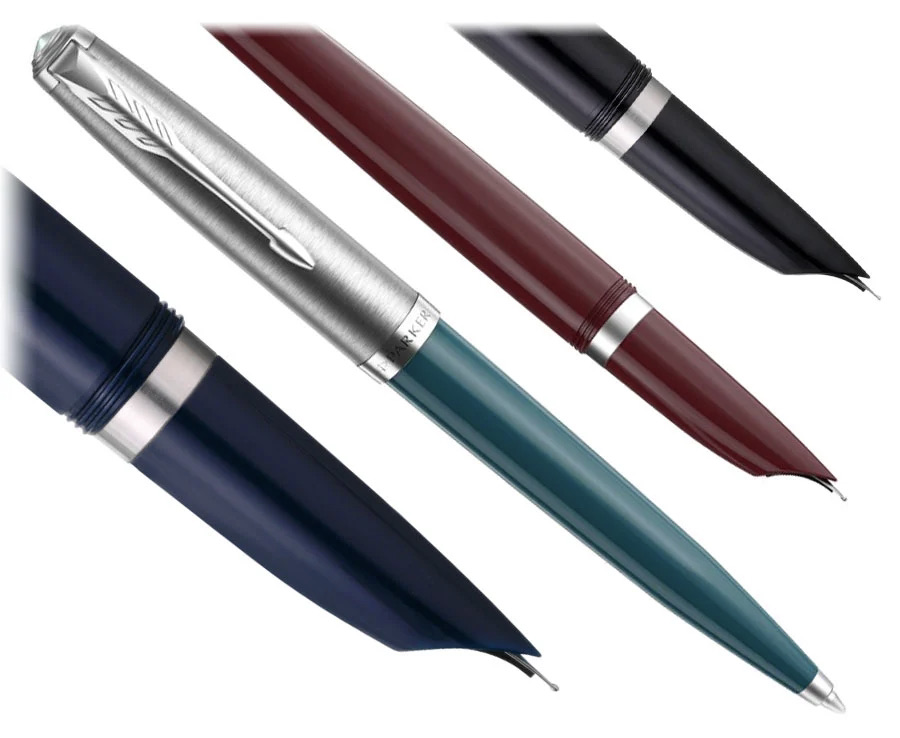
    Originally released in 1933 the Parker 51 has a very interesting look and unique nib design that sets it apart from most other pen models of the time from Parker or any other company for that matter. The 51 was recently revived by Parker due to popular demand and they've stayed pretty true to the original design of the pen. When it first came out in the early 30's the 51 heralded multiple innovative design features with the most notable being the hooded nib, this was to keep the nib wet and provided a better ink flow with less chance for hard starts. Unlike the vintage 51 models the revival is a standard cartridge converter model which is disappointing compared to the vintage aerometric and vacumatic models but is understandable for a revival. 
    The new 51 is available in 2 different types, the first being the ones you see above with the silver caps, these all have stainless steel nibs and come in 4 different colors. The other version of the 51 comes with a gold cap which indicates the 18k gold nib under the hood and this version only comes in 2 colors. You can buy the new Parker 51 at Pen Boutique between $87.20-$248.00 depending on the nib choice you go with.

IM & IM Premium

    The Parker IM is a strong contendor from Parker as far as mid-range pens are concerned and does its job quite well for a respectable price that won't break the bank. The construction of the IM is of various finishes of metal giving the pen a strong feeling without adding too much weight that could throw off the balance of writing. Another benefit is that it is available in a variety of colors which could make them great gifts for students or for someone wanting to have a little fun at work to venture outside of the standard Bic ballpoint. The IM has a steel nib and can be used with either a cartridge or converter, Pen Boutique has 11 color options split between the standard and premium IM models. The Difference between the two is that the premium options have intricately designed metal barrels with patterns on them to just give them that extra push towards elegance and professionalism. The Parker IM can be purchased from Pen Boutique in a staggering 11 colors for a price between $43.56-$79.88 depending on if you choose the standard or premium model.

Sonnet & Sonnet Premium

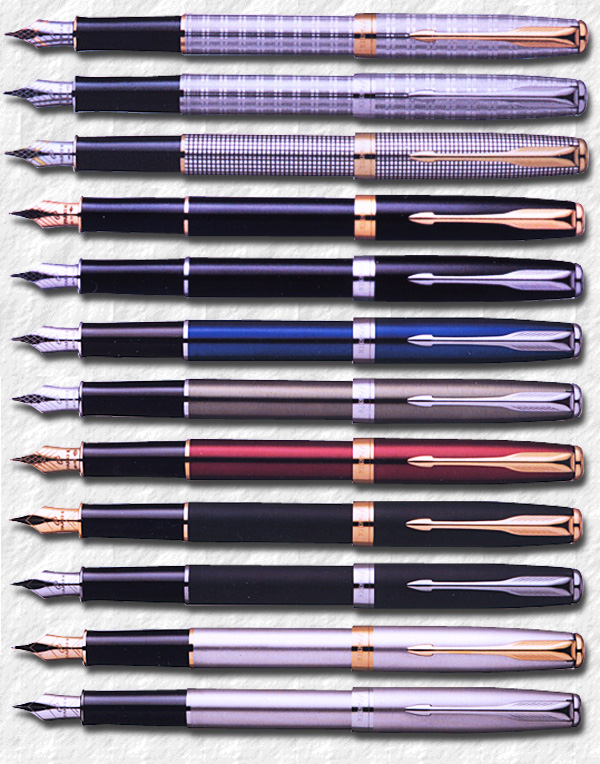
    If you are looking to spend a little more dough than the previous two pen models the Sonnet may be for you. originally introduced in 1994 the Parker Sonnet is the picture everyone has in their mind when they hear the word fountain pen and this renewal of the design brings more colors and even some 18k gold nibs seen on the premium models. I like to think of the Sonnet as sort of the next step or big sibling to the IM because the design feels similar but something about the sonnet feels sleeker and more luxurious, especially with that 18k gold nib. The Parker Sonnet can be purchased at Pen Boutique in 19 different colors and finishes between the base and premium models at a price somewhere between $100-$379.39.

Duofold

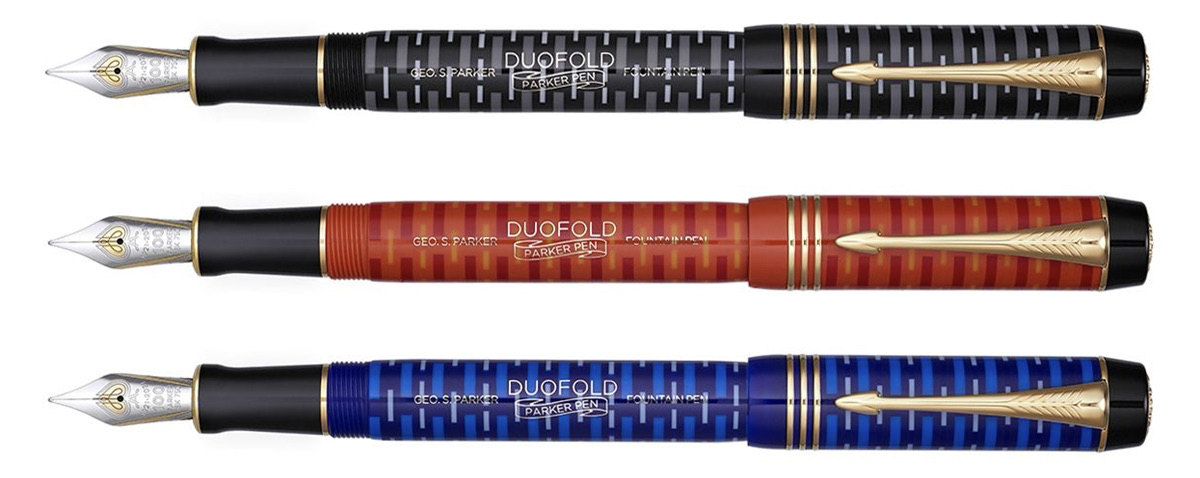
    And finally we arrive at the most iconic and recognizable name in the Parker lineup, none other than the legendary Duofold. Originally introduced in an abundance of sizes and shapes in the 1920's the new Duofold harkens back to Parker's breakthrough design but with a more modern take utilizing more modern and widely available mechanisms. The models pictured above are actually new and commemorate the 100th anniversary of the model in some very interesting patterned acrylic. Overall Pen Boutique has 6 different colors of the Duofold available in-between the price range of $538.64-$1040 and I would highly recommend stopping by to try one out if you have never seen or held one in person, they are wonderful pens and the jewel of Parker's rich history producing writing instruments!
Read more »

Thursday, May 6, 2021

Pen Boutique's Parisian Pen Brand

 A Closer Look at the Waterman Pen Brand

History

    The Waterman pen brand was started by Lewis Waterman after he noticed a lack of reliable fountain pens that held their own ink in the late 1800's. He began working on prototypes and designs of pens that would use capillary action in order to control ink flow and in turn, create a pen that could hold its own ink instead of being dipped. He filed his first patent in 1884 for a pen he called "The Regular" which was distributed out of the back of a cigar shop for the first year. Lewis died in 1901 and his nephew took over the business steadily increasing sales year after year. 
    Jif Waterman was the subsidiary of the American Waterman company that was in Europe and is widely credited for ensuring the continuation of the brand after 1936. Waterman is now recognized as the oldest manufacturer of fountain pens still in production today, over 135 years after the patent for "The Regular". Now that we know the origin of the Waterman pen company, let's take a look at the modern models available at Pen Boutique.

Hemisphere

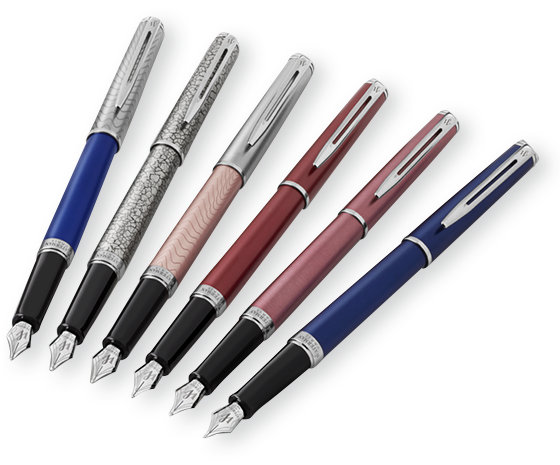
    The most budget friendly and coincidentally the most brightly colored option from the Waterman pen brand is called the hemisphere. These pens have a nice small-midsize silhouette making them a great option for students or people with smaller hands. The primary construction is metal that has been anodized or powder coated to give it a nice splash of color. All hemisphere models have steel nibs which makes sense seeing as how the Hemisphere is a very competitively priced pen. You can purchase the Waterman hemisphere in varying finishes and colors from Pen Boutique in prices that range from $68-$144.94.

Expert

    The Expert is the next step in terms of not only price range but also quantity in terms of what you get for your dollar. I think of the Expert as the older sibling of the Hemisphere because the design is essentially a scaled up version which includes the nib. The Hemisphere sports around a #5 size nib while the Expert has a #6 but it is still a steel nib so we have not yet reached the gold nib pens. There are considerably less color options available but still a good core collection consisting of black, brushed metal, blue, red, bronze and gold. The Waterman Expert in the previously stated variety of colors can be purchased from Pen Boutique for between $138.14-$151.19.

Carene

    This where Waterman starts to get funky (in a good way) in terms of design and offering a bang for your buck. The Carene is made of metal which gives the pen a very solid feeling however it is offered in only three varieties: black with gold trim, black with silver trim, and a very interesting amber color. The most noticeable thing about this pens design is the curved 18k gold nib that gives this pen a very sleek and stealthy look. I must say that the Carene in the amber waves color really is my favorite modern Waterman model due to its loose resemblance of Arco celluloid material and the warm compliment of the gold trim. The Carene can be purchased from Pen Boutique in the 3 options listed above for $233.05.

Exception

    Finally we come to the top of the line, the Exception is no Exception to innovative design (see what I did there...). The most obvious draw to this pen is the unique square shaped barrel that continues to the grip section for a more ergonomic grip. These pens, much like the carene, also have a very satisfying weight that takes the writing experience and elevates it just a bit more. These pens also have wonderfully smooth gold nibs and are sure to look great signing important documents or writing in daily journals alike. The Exception is available in black with gold trim, black with silver trim and blue with silver trim and can be purchased for $356.79 from the Pen Boutique website.

Read more »

Wednesday, May 5, 2021

German powerhouse of affordable writing

 A Closer Look at the Lamy Pen Brand

History

    In 1930 a worker for the Parker pen company decided to leave and start his own legacy, this worker went by the name C. Joseph Lamy. The brand started out under the name "Orthos" and was founded in Heidelberg Germany making it a German institution of fine writing. Later in 1949 after World War 2 the production began on a newly designed series called "Artus", shortly after this in 1952 the brand became "Lamy". 
The same year of the "Lamy" name change they released the Lamy 27 which immediately showed the brands love for innovation and out of the box thinking. The brand would be cemented as a writing powerhouse in 1966 with the release of the first iteration of the brand's 2000 model. The brand now has an annual production of 6,000,000 writing instruments and a turnover exceeding 50,000,000 which has made them both the market leader in Germany along with one of the most globally important German design brands in history. Lamy despite previously being run by family members is now run by the first non-family member in the brands history, Bernhard Rösner. Now that we know a little of the brand's history, let's take a look at the current productions from Lamy that are available at Pen Boutique.

ABC

    The Lamy ABC is a staple of the European classroom where students are often taught to use a fountain pen at an early age. Constructed in a very sturdy way with wood and hard plastic, it's sure to hold up until the student has learned to properly handle a fountain pen. The cap also has a section where the student can write their name to keep track of it in a classroom setting. The benefit of this pen over some of the single use pens offered from other brands is that it can teach responsibility. Both through the students having to keep track of the pen but also learning to clean and take care of the pen. The ABC can be purchased from Pen Boutique at a price of $20.80 in both red and blue.

Safari

    The Safari, in my mind, is the logical "next step" to the ABC but is also a great addition to any collection. constructed of a solid plastic with a removable steel nib, the pen is quite durable and a really good option for the workplace or upper level schooling. Lamy also usually releases some pretty fun colors ever year as special editions, this years additions are both pictured above. This is a better option for people wanting to start writing with fountain pens but may be a little too old for the ABC which can feel a bit small in bigger hands. The Safari can be purchased from Pen boutique in a variety of different colors in the ballpark of $29.60 making it a great option for even the most casual fountain pen enjoyer.

Al-Star

    Very similar to the Safari, the Al-Star is essentially the same pen as the Safari but is made from aluminum instead of plastic which gives a higher quality feel. The aluminum finish makes it even better for keeping in a bag or purse for a quick fountain pen on the go and as it accumulates scratches and dents it gains character specific to you which makes it more personal. This is also great because it provides options in the same great pen for people who like different materials, nice to see Lamy try to please everybody. The Al-Star can be purchased from Pen Boutique for around $37.60 in an abundance of colors including the two special edition colors pictured above.

2000

    My favorite Lamy pen and quite possibly one of the most iconic fountain pens ever, the Lamy 2000 is a timelessly designed workhorse of a pen. The design was based on the Bauhaus principles of design and has remained unchanged for more than 60 years which just shows the timelessness of the design. The pen comes in both a Makralon finish (pictured above) and a stainless steel version that is a little bit more money. The hooded design on this gold nib keeps it wet and reduces the chances of hard starts and skipping which makes this a fantastic workhorse pen. The piston design also allows for a large ink capacity and for these reasons I don't think I'll ever let go of my Lamy 2000, its got a permanent spot in my collection for sure. The Lamy 2000 can be purchased through Pen Boutique for $199.20 or $319.20 for the stainless steel version.

Dialog

    Another prime example of Lamy's great and out of the box design concepts, the Dialog is kind of like Lamy's vanishing point. The Dialog has the same nib profile as the Safari and the Al-Star but its gold instead of steel which means that nibs can be swapped from different Lamy models. You'll notice the pen doesn't have a cap and instead you have to twist the body of the pen to expose the nib for writing and instead of having the clip away from your grip it is in the center of your grip. The construction of the dialog is also a very sturdy one that is sure to stand the test of time. The Dialog can be purchased through Pen Boutique for around $319.20 in palladium, black and white.
Read more »

Thursday, April 29, 2021

Spice up your collection with Sailor's new LE

Sailor Pro Gear

Too Hot Habanero

Specs:

  • Description- A hot new take on a classic Sailor model

  • Nib- 14k or 21k gold depending on size

  • Material- Resin

  • Filling Mechanism- Proprietary converter/cartridge

  • Weight- 22 Grams

  • Measurements- 5.06" capped, 5.80" posted

  • Ink Capacity- .68ml converter, 1.19ml cartridge

History & Origin:

    The Sailor brand started when its founder, Kyugoro Sakata, was first introduced to fountain pens in 1911 by one of his sailor friend's who showed him a pen from Europe. Inspired by what he saw, he quickly became determined to craft a pen of superior quality and decided on the name Sailor in hopes that the brand would expand all over the world much like a sailor on a sea voyage. Mr. Sakata was a pioneer of the Japanese fountain pen with his brand being the first to produce fountain pens in Japan and currently one of the longest running brands in the industry. The Pro Gear is the bigger version of the Pro Gear slim and has a 21kt gold nib with the slim having a 14kt nib. The pen is offered in seven different nib sizes including Extra Fine, Fine, Medium-Fine, Medium, Broad, Zoom, and Music.

Packaging & Appearance:

    This pen comes in the standard clamshell box that most other regular sized Sailor's come in and that box is lined with a soft satin like material to keep the pen free from scratches. Inside the box you'll not only find the pen but also a converter and 2 cartridges so you can get writing right away. The pro gear is a very similar pen to the 1911 which is Sailor's other main pen body and the main difference between the two is that the Pro Gear has flat ends while the 1911 is a more traditional cigar shape. This special edition reminds me of some of the cocktail series pens that Sailor makes each year due to the mixing of both opaque and transparent resins, this breaks the pen up visually and gives it an interesting look. The finial of this pen is also unique and sports the image of a chili pepper instead of the usual Sailor anchor logo which is a fun little touch that sets this pen apart. The demonstrator body doesn't just look nice but also allows the user to keep and eye on ink level because regular opaque versions of the Pro Gear don't have ink windows so its nice to see on this LE. My only gripe, and this is completely a matter of personal opinion, is that I can't help but think gold colored trim would match the warm orange colors of the pen more but the silver looks good too. Now that we've taken a closer look at appearance, how does it write?

Nib & Performance:

    If the rich history of Sailor wasn't enough to convince you about the brands uniqueness their nibs sure will. Sailor makes all of their nibs in house which means they have complete control over the entire production process which allows them to fine tune each nib to their exact standards which in turn yields a superior product. I find that both their #5 (14k) and their #6 (21k) tend to be rather stiff with some feedback akin to writing with a sharpened pencil and is by no means a bad feeling but one that Sailor has grown to be known for. The nibs on their oversized king of pen models tend to have a little more give and offer a tad more line expression than the regular sized nibs. Ink flow is medium until you go up to the zoom and music nibs, both of which can be pretty wet and in turn, show off the intricacies of the ink in use. Sailor knows how to make pens and they know how to make them well, I've never had a problem with the two that I own performance or nib wise.

Pros:

  • Eye-catching
  • unique finial
  • NA exclusive

Cons:

  • Increased price from regular PG models
  • relatively small ink capacity

Price & Conclusion:

    Sailor's NA exclusive pens never disappoint and this is no exception, the bright color and unique mix of materials is sure to stand out in even the most expansive collections! Pen Boutique is a licensed seller of Sailor products and we are selling the slim model for $280 and the standard model for $392. Please feel free to stop by and take a look for yourself or contact us with any questions you may have, Remember to Enjoy & Keep writing! 
-Kyle
Read more »

Saturday, April 3, 2021

New pens for all the homosapiens out there

 Visconti's New Homosapiens Offerings

    I've written about the Homosapiens model before and the edition I wrote about was last year's "Blue Lagoon" model and since that came out Visconti has broadened the horizons of what the HS line can be perceived as. Before I go off talking about the new colors let me just copy and paste a quick introduction to the brand and the HS line that I wrote for my original Blue Lagoon review. The brand Visconti was founded in 1988 in Florence Italy and their Italian heritage shines through in the products they make to this day. Founded by Luigi Poli and Dante Del Vecchio, two avid fountain pen collectors at the time, the brand has had collectors and enthusiast in mind from the very start. All of Visconti’s pens and writing instruments are designed in a 15th century Florentine villa that shows the brands dedication to the past masters of Italian artwork. While Visconti has a lot of different lines and collections, the Homo Sapiens line is their homage to nature. The original homo sapiens is dedicated to the volcanoes of Italy, even using a mix of natural Basaltic Lava on the regular Homo Sapiens models but the line is ever expanding as you'll see with the pens I'm introducing in this blog. Alright, now that the history lesson is out of the way I'll talk about the first of two of the new Homo sapiens editions, the "Tuscan Hills".

Visconti H.S. Tuscan Hills 888

Aesthetics-    A lot like the other 888 versions of the H.S. this one is based upon another aspect of nature with the specific element being earth, last year's Blue Lagoon was based on water. However something a little different about this version is that this one's material is not quite as see through as the previous 888 editions, instead they decided to go with a more opaque resin that is still a little see through but not to the point of being able to see the internal vac filler rod or the ink color clearly. 
This decision was a good one that lends itself to the name tuscan hills because nothing about dirt, earth or ground is see-through so it is more true to form in this respect by not having it be completely see through. Visconti is also doing a little bit of a refresh with some of their products and logos recently, a refresh that I don't prefer over how things were before and its nice to see that the 888 is the same as previous versions in respect to the nib stamping and packaging however it is unclear to me whether the magnetic my pen insert at the top bears the old Visconti logo or the updated modern one. 

Performance-      It's no secret by now that Visconti makes beautiful writing instruments of exceptional quality and the homo sapiens model is one of the brands most iconic lines which means it may get a little extra attention to detail at the end of the day. I must admit that it is unclear if this model still uses the bock nibs found on earlier versions of the H.S. models or if they have opted for the new Visconti in-house nibs that are featured on the multi-colored lava models.
(Image for reference, Comes with a single tone nib)
In either case the pen will write very well, the bock nibs did have a small history of needing adjustments out of box but it really isn't too big a deal and its something that has been mostly fixed with the introduction of the in house nibs. The thing that makes me keep coming back to my H.S. is the ink capacity, this pen can out write some of the other offerings from other brands that are in this price bracket which makes it one of the best workhorse pens for everyday writing. This pen even holds more ink than the 823 from pilot which is often cited as a pen with a huge ink capacity, pretty much the only way to get a bigger capacity would be to purchase an eye dropper pen which are decidedly less common. 

Visconti H.S. Demo Stones

Aesthetics-    Seeing as how this is also a member of the Homo sapiens family the pen is pretty much the same in size and shape but the difference is obviously in the color options. For this 3 color collection Visconti was inspired by the beauty and opulence of precious stones and seeing as how there is a red, blue and green pen the stones in question are rubies, sapphires and emeralds. The addition of these colors are quite nice for the Homo sapiens line because it means that a full demo version of the model will always be available and not exclusive to the more limited editions. It is true that they has the skylight and crystal dream which both featured ink windows but these are the first full demos to be added if my memory serves.
One thing slightly different about these models is that in place of an emblem bearing the Visconti logo on the cap, they have an insert with a domed piece of the same color material as the pen to make it look like a cabochon gem insert. 

Performance-    The performance of these pens is going to be similar to the Tuscan hills but I know that these have the new in-house nibs so that is a nice touch but other than that performance and ink capacity is nearly the same!

Swing by and see these fantastic new colors in person, you can also try the nibs out if you've never written with a H.S. before but be warned, once you pick one up its hard to put it down! Oh, one more thing, remember to enjoy and keep writing!
-Kyle

Read more »

Wednesday, March 3, 2021

A new SHIPment of Sailors just arrived!

 New Sailors Come Aboard at Pen Boutique!

    Hello all you pen friends out there, this is Kyle and I'm writing this blog about something that inspired me today. As some of you may now by now, I'm back at my apartment in Japan and am writing our blogs remotely but today was a holiday in Japan which meant I had off from uni. With my whole move back to Japan I wasn't able to take any of my ink with me so I decided to venture out and get myself some new ink, I purchased Sailor's ink studio 141, 730, 653, 473 all of which can be purchased at Pen Boutique, but while I was out on this ink buying adventure I saw a couple pens up close that caught my eye. It just so happens that we carry these pretty limited Sailor models at Pen Boutique! Due to the nature of our relationship with the brand we are very fortunate to get a couple rarer options to stock and those are what I'll be showing you and talking a little bit about in this blog so let's just get straight into it!

1911 Large Bespoke Nibs


    If you are familiar with Sailor you'll know that the 1911 model is an homage to the brands beginnings and bears the founding year of the brand in the name. Don't let these black and gold cigar shaped pens fool you, they are not your average cigar shaped pen and the nibs are what really set them apart. Sailor manufactures all of their own nibs in house which means they can control the manufacturing process completely and that gives them freedom to do the unique grinds you can see in this dealer exclusive line of pens. This line has fude, concord, Naginata Togi, and cross point nibs which is really unique to have brands actually offer these directly from themselves as opposed to having a third party do work on the nib which is the only way to get these nibs from other brands usually. As you can see from the above picture, some of these nibs look as if they've been dropped or that they wouldn't write but that is the result of meticulous and precise alignment that gives the writing from the nib a very unique character. For Example, the middle nib in the picture is called a "Fude" and this nib will have an extremely wide line due to the increased surface area that is caused by bending the nib up however reverse writing with this type of nib is not recommended, the bottom nib is called a concord nib and is essentially the opposite of the fude, the nib is bent down instead of up and the benefit of this is that you are getting the best of both worlds with a narrow line initially but when reverse writing you get the same result as a fude!
Cross Music Nib
This wonderful and unique line of pens is available between $660-$900 depending on the complexity of the nib and construction, drop by and see them in person if you are nearby!

Iro Miyabi King of Pen

    This pen is another unique version of one of Sailor's most noteworthy models, the "King of Pen" which is of course, their own oversized flagship pen akin to the 149 or M1000. This new addition to the K.O.P has an ebonite body as the base of multiple layers of Urushi lacquer that is applied in the "Ishime Nuri" technique which gives the pen the unique look and texture. The thing I found really interesting about this model is that the section also has the Urushi work applied to it and if you are familiar with the regular ebonite K.O.P you know that the section is plastic instead of ebonite.
This is just an interesting little detail that sets it apart from the ebonite version and also begs the question of whether the section on this pen is still plastic or if they made it in ebonite specially for this model. Iro means color and Miyabi means elegant which means the direct translation of this model is "Elegant color" and each of the four colors represent elegance and gracefulness in the eyes of Sailor. You have the usual M or B 21k oversized nib option that is standard on most K.O.P models and they are available at Pen Boutique for $1,600 regardless of color.

Sailor Luminous Shadow

    These pens sport a couple similarities to the previously mentioned "Iro-Miyabi" line in that they are also using the 21k oversized nibs and they are also available in four distinct colors however these aren't exactly King of Pen sized. When I originally saw these I did think they were K.O.Ps but on closer inspection you can see both ends are flattened similar to the pro gear but it is more severe on these models. Another thing that sticks out is the interesting single cap band design that sports a somewhat modern font and definitely breaks from the normal K.O.P cap band design. Another unique part of this pen is that all the trim including the nib is "shadow" colored which is similar to what is seen on the "Wicked Witch" 1911 models but this is the first time they are doing it on an oversized pen to my knowledge.
I also like that they made the section from the same material the whole pen is made out of which, as I previously mentioned, is not a feature on the standard ebonite models and I just feel it gives a better sense of overall coherence. These pens are still Cartridge/Converter which is standard with the K.O.P models and while it would be wonderful to someday get a "Realo" or piston filling K.O.P I am fine with the converter. The pens are made from a marbled turned acrylic that make each pen unique much like how shadows are ever changing. These are extremely limited and only 300 pieces per color are available world wide so be sure to act fast! The Sailor Luminous Shadow models in all colors are available at Pen Boutique for $1,100 each. 

    I hoped you enjoyed this quick look at some of the most unique Sailor models we have currently available at Pen Boutique and while I'm not currently in Maryland, I did have the opportunity to go to some of my local shops here in Tokyo to take a hands-on look at all the models listed above which inspired the idea for this blog! Remember to stay safe in regards to covid as well as enjoy & keep writing!
さようなら、Kyle
Read more »

© 2016-2018 Pen Boutique.com. All rights reserved Privacy Policy Terms of Use